"Why am I crying because someone used the wrong tone?"
"Why can't I just let things go?"
"Why does one tiny inconvenience ruin my entire day?"
"Why do I feel everything so...much?"
Can we talk about the part of ADHD that nobody warns you about?
Not the lost keys.
Not the laundry sitting in the dryer for three days.
Not buying another planner because this one is definitely going to change your life.
(For the record...I fully support the delusion. There’s always hope in aisle seven at Target.)
😂

I'm talking about the part where someone sighs a little too loudly...
...and suddenly you're questioning every life decision you've ever made.
The part where your husband asks,
"Did you remember to pay the electric bill?"
And somehow your brain hears,
"You're failing at adulthood."
The part where your favorite coffee shop is out of oat milk...
And now you're irrationally wondering if you should just move to another state.

Too dramatic?
Maybe.
Relatable?
Absolutely.
Because when people talk about ADHD...
They usually talk about focus.
Productivity.
Organization.
Time blindness.
Executive dysfunction.
Those things matter.
But there's another symptom that quietly wrecks relationships...
Destroys self-esteem...
Makes women think they're "too sensitive"...
And often gets completely ignored.
Emotional dysregulation.
And friend...
It's time we talked about it.

The Day I Cried Over a Can of Soda
I wish I were making this up.
One morning I was already running behind.
I couldn't find my phone.
The dog needed to go out.
My coffee was getting cold.
I had approximately sixteen tabs open in my brain before I'd even opened my laptop.
Then I reached into the fridge.
I grabbed a soda.
Dropped it.
It rolled across the kitchen floor.
And...
I cried.
Not graceful movie tears.
Not one little tear rolling dramatically down my cheek while inspirational music played.
No.
The ugly cry.

Over.
A.
Soda.
Now, if someone had walked into my kitchen at that exact moment, they would've thought,
"Wow...she is really passionate about her beverages."
But it wasn't about the drink.
It never is.
The soda was simply the final Jenga block.
Everything else had been stacking all morning.
Stress.
Overwhelm.
Mental load.
Decision fatigue.
ADHD.
Sleep.
Hormones.
Pressure.
The soda was just...
The soda.

And if you've ever burst into tears because someone asked, "What's for dinner?"...
Or felt completely defeated because your Amazon package was delayed...
Or gotten irrationally angry because your shirt caught on the doorknob...
Friend...
You are not crazy.
And you are definitely not alone.
Let's Talk About What's Really Going On
Here's the thing.
People often think ADHD is a disorder of attention.
It isn't.
Not entirely.
It's really a disorder of self-regulation.
That includes attention.
But it also includes:
regulating emotions
regulating impulses
regulating frustration
regulating motivation
regulating reactions
In other words...
Your brain isn't just struggling to stay focused.
It's struggling to shift gears emotionally.

Imagine driving a car.
Most people's emotional brakes work pretty smoothly.
Something upsetting happens...
Their emotions rise...
They slow down...
Then eventually return to normal.
An ADHD brain?
Sometimes it's like someone accidentally cut the brake lines.
Everything feels immediate.
Everything feels intense.
Everything feels urgent.
Everything feels personal.
Not because you're weak.
Because your brain processes emotion differently.
Wait...
Isn't This Just Anxiety?
Such a good question.
And honestly...
This is where so many women get confused.
Because ADHD and anxiety love to hold hands.
Sometimes they're practically wearing matching outfits.
Anxiety says...
"Something bad might happen."
Emotional dysregulation says...
"Something bad just happened...and my emotional response is now at DEFCON 1."
Anxiety tends to live in anticipation.
Emotional dysregulation often explodes in the moment.
Sometimes they're together.
Sometimes they're separate.
Sometimes one creates the other.
For example...
You're running late because of ADHD.
Now you're anxious.
Someone honks at you.
Now you're emotionally dysregulated.
Then you spend the next three hours replaying the interaction in your head...
Wondering if the stranger in the blue Honda still thinks you're irresponsible.
Tell me your brain doesn't do this.
"You're Too Sensitive."
Can we retire this phrase forever?
Seriously.
I think women with ADHD have heard this our entire lives.
You're too emotional.
Too dramatic.
Too reactive.
Too intense.
Too much.

Eventually...
You start believing it.
You start apologizing for your feelings before you've even had them.
You begin editing yourself.
Masking.
Shrinking.
Pretending everything's fine.
Meanwhile...
Inside...
You're carrying emotional earthquakes that nobody else can see.
Here's what breaks my heart.
Many women spend decades believing they're emotionally immature...
When they're actually experiencing a neurological difference.
Those are not the same thing.
The Research Is Finally Catching Up
For years, emotional dysregulation wasn't even included in the official diagnostic criteria for ADHD.
Yet clinicians kept seeing it.
Patients kept describing it.
Researchers kept studying it.
And now?
The evidence is becoming hard to ignore.
Research suggests that between one-third and more than two-thirds of adults with ADHD experience clinically significant emotional dysregulation, depending on how it's measured. That's a huge proportion of the ADHD population.
Another review concluded that emotional dysregulation is one of the most impairing features of adult ADHD, affecting work, relationships, parenting, and overall quality of life—even though it isn't currently listed as a core diagnostic criterion.
Think about that for a second.
One of the symptoms causing some of the deepest shame...
Was barely talked about for years.
No wonder so many women thought they were simply "bad at emotions."
Why Everything Feels So Big
Imagine your emotions have a volume knob.
Most people experience something frustrating...
The volume goes to about a four.
Maybe a five.
With ADHD...
Sometimes the volume shoots to eleven before your thinking brain even has time to catch up.

It's not that you're choosing a bigger reaction.
It's that your emotional response is arriving at full speed.
Researchers believe this involves differences in brain networks responsible for emotional regulation, including the prefrontal cortex—which helps with impulse control and regulation—and its communication with emotional centers like the amygdala.
Those same networks are already involved in executive functioning, making emotional control even harder when you're overwhelmed.
That's why you might think...
"I KNOW this isn't that big of a deal..."
...while simultaneously feeling like it is.
Logic and emotion are running at different speeds.
And that's exhausting.

The Invisible Grief of ADHD Women
Here's something I don't think we talk about enough.
Sometimes it's not the emotions themselves that hurt the most.
It's the shame afterward.
You snap at someone you love.
Now you feel guilty.
You cry at work.
Now you're embarrassed.
You overreact.
Now you're apologizing.
Again.
You think, "Why can't I just be normal?"
Friend...
Can I gently push back on that question?
What if the goal was never to become "normal"?
What if the goal is to understand your brain so well that you stop declaring war on yourself?
Because those are two very different goals.
And one of them is actually possible.
So...What Do We Do About It?
Okay. Deep breath.
Because this is the part I wish someone had taught me years ago.
You cannot always control your first feeling.
But you can learn to influence what happens next.
That isn't about pretending you don't have ADHD.
It isn't about becoming emotionally numb.
It isn't about stuffing everything down until one day you explode because someone loaded the dishwasher "wrong."
(Hypothetically speaking, of course.)
It's about learning to work with your brain instead of constantly fighting against it.
Strategy #1
Name It Before You Judge It
This sounds almost ridiculously simple.
It's also surprisingly powerful.
The next time you notice your emotions climbing...
Pause.
Instead of saying, "I'm ridiculous."
Try saying, "I'm overwhelmed."

Instead of, "I'm overreacting."
Try, "My nervous system is activated."
Instead of, "What's wrong with me?"
Ask, "What's happening inside me?"
Notice the difference?
One question creates shame.
The other creates curiosity.
And curiosity is almost always more helpful than criticism.
Strategy #2
Look for the Stack
Remember the soda?
The soda wasn't the problem.
The stack was.
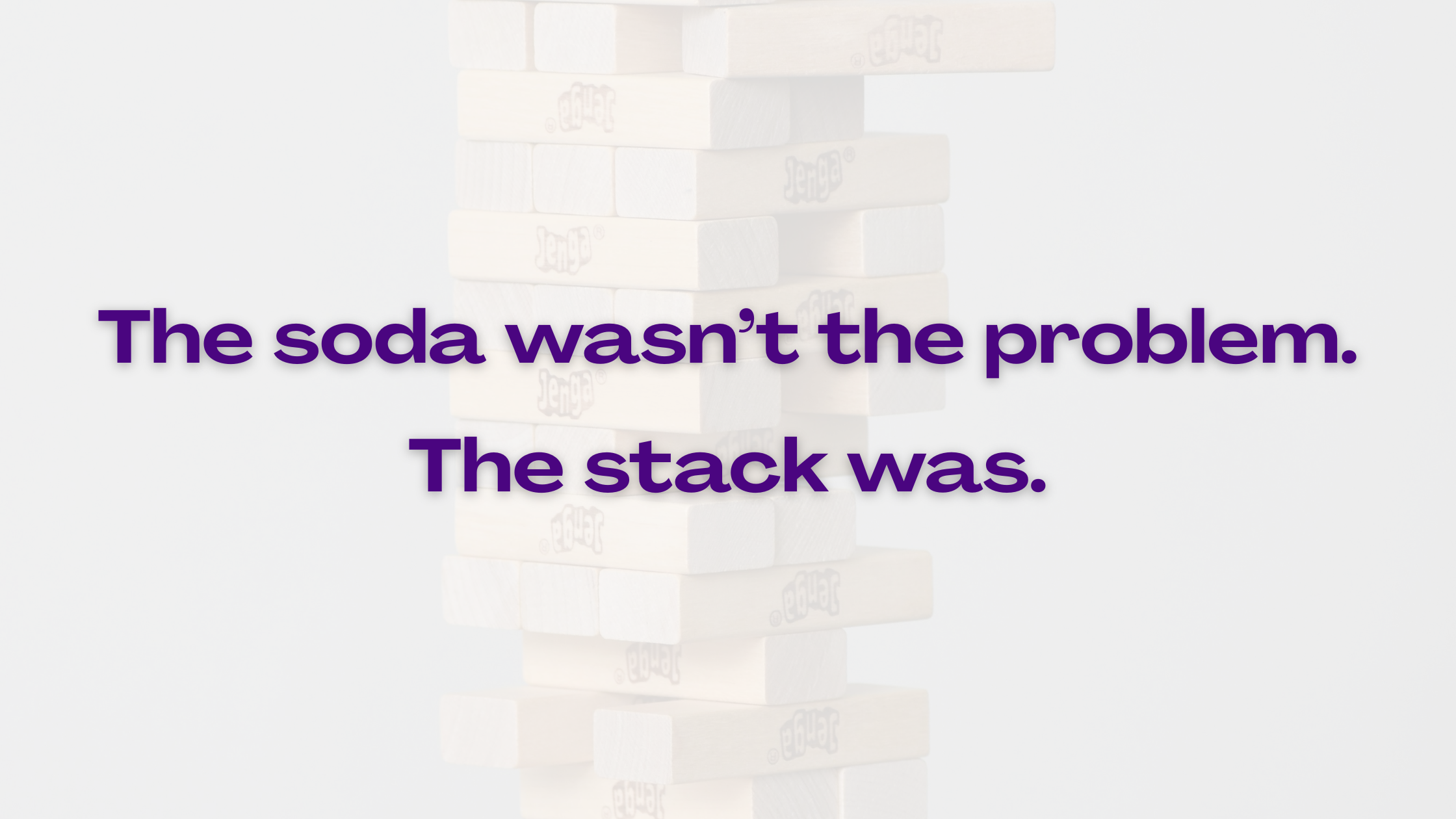
Most emotional explosions don't come from one event.
They come from ten little things piling on top of each other until your nervous system quietly says,
"I'm out."
So the next time you feel yourself spiraling, ask:
Did I sleep well?
Have I eaten?
Have I been making decisions all day?
Am I overstimulated?
Am I masking?
Have I had any quiet time today?
Am I already emotionally carrying something else?
Sometimes the answer isn't, "I'm too emotional."
Sometimes it's, "I've been carrying twelve invisible bricks all day."
Of course the thirteenth one felt heavy.
Strategy #3
Borrow Time
One of the hardest parts of emotional dysregulation is that it creates urgency.
Everything feels like it needs to be solved...
Right now.
Respond right now.
Text back right now.
Quit your job right now.
Delete social media right now.
Move to a cabin in the woods with seventeen rescue dogs...
Right now.
(Okay...that last one still sounds kind of amazing.)
Here's what I've learned.
Very few emotional decisions improve because we make them quickly.
Many improve because we give our thinking brain time to catch up.
Try saying: "I don't need to solve this in the next five minutes."
That sentence alone has saved me from more regrettable text messages than I care to admit.
Strategy #4
Stop Trusting Every Feeling
Now hear me carefully.
Your feelings matter.
They deserve compassion.
They deserve attention.
But...
They are not always accurate reporters.
Just because you feel rejected...
Doesn't mean you've been rejected.
Just because you feel like everyone is judging you...
Doesn't mean they are.
Just because you feel like you've failed...
Doesn't mean you have.
ADHD—and anxiety, for that matter—can make emotions feel incredibly convincing.
But convincing isn't the same thing as true.
One of the healthiest habits I've ever developed is asking:
"What are the facts?"
Not..."What does my fear think?"
Not..."What story is my brain telling?"
Just..."What do I actually know?"
Sometimes that one question lowers the emotional volume enough for wisdom to finally get a word in.
Strategy #5
Build Emotional Recovery Instead of Emotional Perfection
Can I tell you something that changed the way I think about emotional health?
Emotionally healthy people aren't people who never get dysregulated.
They're people who recover.
That's a completely different goal.
I used to think success meant,
"I never cry."
"I never get overwhelmed."
"I never overreact."
Now?
Success looks more like this.
"I recovered faster."
"I apologized sooner."
"I showed myself grace."
"I came back."
That's growth.

The Science of Self-Compassion
Here's something fascinating:
Research has found that people who practice self-compassion tend to experience lower levels of anxiety, depression, and emotional distress, along with greater emotional resilience.
Contrary to the fear that self-compassion makes people complacent, it actually supports healthier coping and persistence.
Think about that.
Many of us believe beating ourselves up will motivate us.
Research suggests the opposite.
Kindness doesn't weaken resilience.
It strengthens it.
Imagine speaking to yourself the way you'd speak to your best friend.
Not because you've earned it.
Because you need it.
The Confidence Receipts You Never Counted
Can I point something out?
You've been collecting emotional confidence receipts your whole life.

You survived that panic attack.
Receipt.
You had the hard conversation.
Receipt.
You walked into therapy even though you were terrified.
Receipt.
You kept parenting on the days you wanted to hide under the covers.
Receipt.
You made it through grief.
Receipt.
You started over.
Receipt.
You got out of bed this morning.
Receipt.
We tend to celebrate the big milestones.
Published the book.
Landed the job.
Launched the business.
But emotional courage often looks much quieter.
Sometimes courage is simply choosing not to give up.
And friend...
That counts.
What If You Stopped Calling Yourself "Too Much"?
I wonder how different our lives would look if we stopped measuring ourselves against nervous systems that don't work like ours.

What if...
Instead of saying, "I'm too emotional,"
You said, "My brain experiences emotions intensely."
Instead of, "I'm failing,"
You said, "I'm learning.”
Instead of, "I'm broken,"
You said, "I'm understanding myself better than I ever have before."
Those aren't just nicer words.
They're more accurate.
And accuracy matters.
The Woman You're Becoming
I know it doesn't always feel like it.
I know there are days when you wish your brain came with an instruction manual.
I know there are moments when you're exhausted from feeling everything so deeply.
But can I tell you something I genuinely believe?
Some of the women with the biggest hearts...
The deepest compassion...
The fiercest loyalty...
The strongest intuition...
Also happen to feel emotions intensely.
The goal isn't to stop feeling deeply.
The goal is to stop drowning in what you feel.
There's a difference.

You don't need to become less sensitive.
You need better tools for carrying your sensitivity.
Because your emotions aren't your enemy.
They're just asking for a wiser guide.
One Last Thought...
Maybe emotional dysregulation isn't proof that you're failing.
Maybe it's proof that your nervous system has been working overtime for years.
Maybe your tears weren't weakness.
Maybe they were exhaustion.
Maybe your frustration wasn't immaturity.
Maybe it was overwhelm.
Maybe your sensitivity wasn't a flaw.
Maybe it was humanity.
Friend...
There is nothing weak about learning how to lead yourself when your emotions are loud.
In fact...
That might be one of the bravest things you'll ever do.
So the next time you cry over the soda...
Or the shirt that got caught on the doorknob...
Or the text message that sounded a little shorter than usual...
Pause.
Take a breath.
Offer yourself the kindness you'd so quickly give someone else.
And remember...
You are not your worst moment.
You are not your loudest emotion.
You are not too much.
You are learning.
You are growing.
You are becoming.
And every single time you recover instead of giving up...
You're collecting another confidence receipt.
One brave step.
One deep breath.
One moment of grace at a time.
Because healing isn't about never getting dysregulated again.
It's about believing you can find your way back.
And friend...
You always can.