
You send a text.
They don’t answer.
Your brain, apparently operating a full-service disaster production company, gets to work.
They’re mad at me. I said something wrong. I’m too much. This friendship’s over. Should I apologize? Move? Change my name and raise goats?

Girl. We started with a text message. How did we end up in witness protection?
That’s what spiraling can feel like: one thought becomes five, five become fifty, and suddenly you’re mentally defending yourself in a courtroom nobody actually booked.
And then comes the advice:
“Just stop thinking about it.”
Oh, excellent. Let me locate the off switch next to the laundry I forgot to move to the dryer.
If it were that easy, you’d have done it already.
Here’s a different place to start: you don’t have to defeat every thought before you can take your next step.

When Thinking Stops Helping
There’s a difference between working through a problem and repeatedly circling it.
Working through a problem might sound like:
I missed a deadline. I’ll email them, explain briefly, and give them a realistic update.
Spiraling might sound like:
Why am I like this? What if they think I’m incompetent? What if everyone thinks that? Let’s revisit every mistake I’ve made since 1994.
One leads toward a decision. The other keeps reopening the same emotional browser tabs.
Try asking yourself:
“Am I finding new information or a useful next step—or am I replaying the same fear?”
You don’t need to shame yourself for the answer. You’re noticing where you are so you can choose what comes next.
You Don’t Have to Win the Argument
Sometimes examining a thought helps. You look at the evidence, consider another explanation, and feel a little steadier.
Other times, every answer invites another anxious question.
But what if?
Okay, but what if THAT?
Fine, but have we considered this highly specific catastrophe involving three unlikely events and a suspicious email?

If debating your thoughts keeps you stuck, you can try changing how you relate to them. Acceptance and commitment therapy uses a skill called cognitive defusion: recognizing a thought as a thought, rather than automatically treating it as a fact or instruction. The VA describes this as an alternative when directly challenging thoughts increases distress.¹
In everyday language: your brain can have an opinion without getting control of your whole afternoon.
1. Name What’s Happening
Try a simple observation:
“I’m noticing a spiral.”
Or:
“My mind’s replaying the conversation again.”
Skip the insult that wants to follow. You don’t need to add because I’m ridiculous or because I can’t handle anything.
A difficult moment doesn’t need a character assassination attached to it.
If humor feels helpful, you might say, “Ah. The disaster committee’s called another meeting.” If you’re too upset for humor, plain words are enough.
You’re allowed to be kind to yourself without turning the moment into a comedy special.
2. Put a Little Space Around the Thought
Instead of:
I’m going to mess everything up.
Try:
“I’m having the thought that I’m going to mess everything up.”
That phrasing is a defusion practice. It helps distinguish what your mind’s saying from what’s actually happening.²
You don’t have to make the thought disappear. You don’t even have to feel convinced by the new wording.
You’re practicing noticing the sentence rather than immediately obeying it.
Think of Kevin the squirrel showing up in glitter pants with a clipboard labeled Potential Disasters.
You can notice him. You can acknowledge the outfit. You don’t have to let him manage your calendar.

3. Reconnect With What’s Here
When your mind’s sprinting into tomorrow, try giving your attention something concrete in this moment.
Notice your feet against the floor. Look at an object and describe its color and shape. Listen for a sound in the room.
Mindfulness guidance from the NHS includes noticing present sensations and gently returning your attention when your mind wanders.³
No elaborate setup required. You don’t need a mountain retreat, twelve candles, or a woman named Willow ringing a tiny bell.
You can practice beside the dishwasher.
If focusing inside your body feels uncomfortable, try keeping your eyes open and noticing things around you instead.
The worry might still be there. You’re making room for the rest of your surroundings, too.
4. Ask: “Is There Something I Can Do?”
The NHS recommends separating problems you can act on from hypothetical worries beyond your control.⁴
Ask:
“Is there a practical step I can take now—or plan for later?”
If yes, choose one manageable action. Send the update. Write down the question. Put the appointment on your calendar.
If no, acknowledge the uncertainty: I don’t have an answer right now. Then return to something you’ve chosen to do.
For example, you can send a clear message. You can’t guarantee the other person’s reaction.
You can prepare for a presentation. You can’t personally supervise every audience member’s facial expression.
Which is unfortunate, because apparently we’d like to.
5. Give the Worry a Place to Land
Some concerns deserve attention—just perhaps not during dinner, bedtime, and every quiet second in between.
The NHS suggests writing worries down and setting aside a short daily “worry time,” such as 10–15 minutes, to review them and consider solutions.⁵
You might jot down:
I’m worried about next month’s expenses. I’ll review the numbers tomorrow at 10.
When the worry returns, gently remind yourself that you’ve made a plan to revisit it.
This isn’t a promise that your brain will respect office hours immediately. It’s a practice. You may need to redirect your attention more than once.
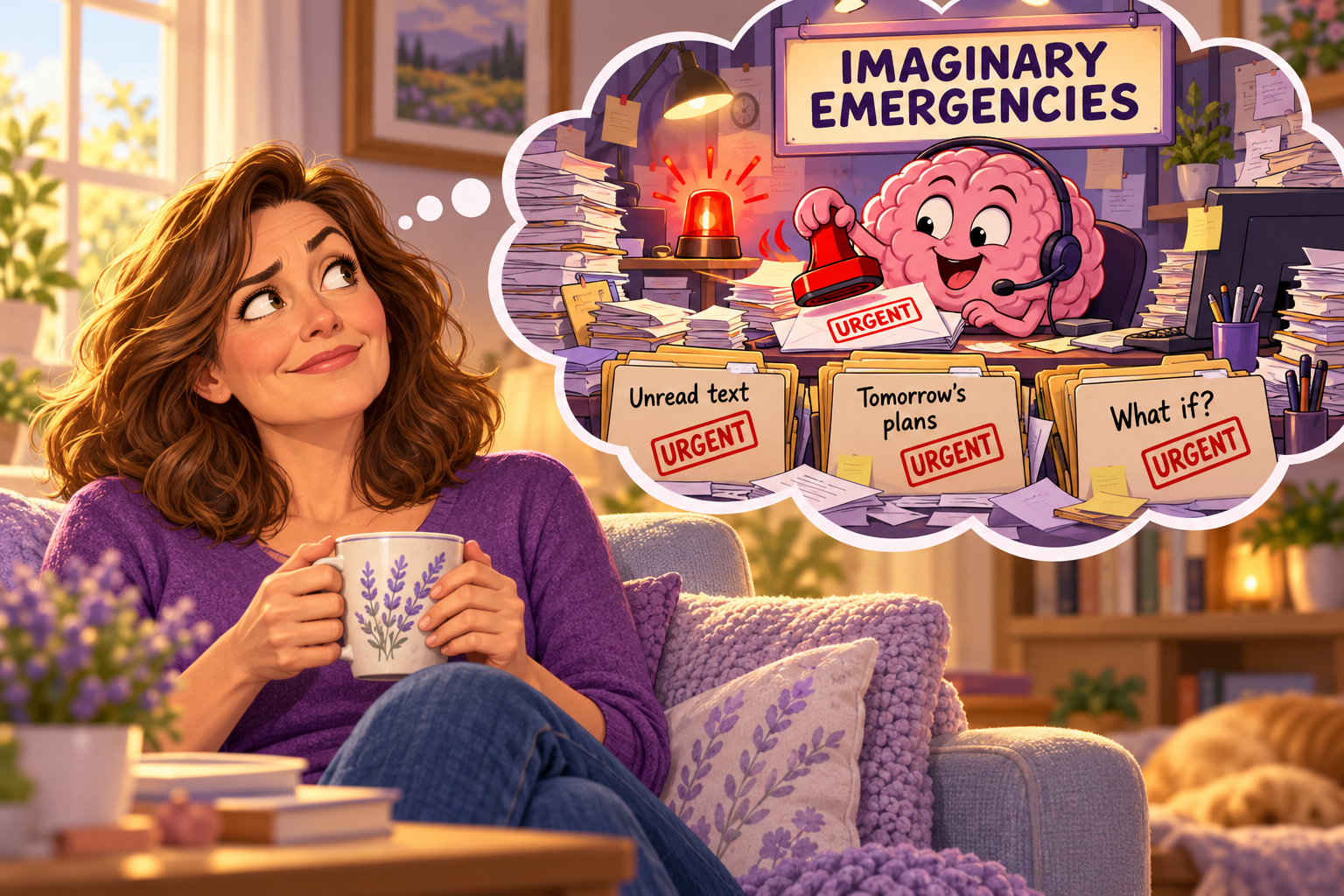
Actual urgent problems still deserve timely attention. The imaginary emergency department in your head doesn’t get to label every uncertainty urgent.
6. Take One Small Step Toward Your Life
Ask yourself:
“What would I like to give my attention to for the next two minutes?”
Maybe that’s eating lunch, opening your document, stepping outside, or listening to your daughter finish her story.
Choose something that matters to you. Keep it small enough to begin while the thought’s still chattering.
You might say:
I’m worried they’re upset with me, and I’m going to eat my lunch.
I’m having the thought that I’ll fail, and I’m going to write the first sentence.
You’re allowed to do something meaningful before you feel completely settled.
Q&A: But What If My Brain Has Follow-Up Questions?
What if the thought is actually true?
Then a practical response may be needed. You might owe someone an apology or need to fix a mistake.
Acknowledging the thought doesn’t mean dismissing the facts. Ask what useful action the situation calls for.
Replaying it endlessly isn’t the same as repairing it.
Does accepting a thought mean agreeing with it?
No. In this context, acceptance means allowing the experience of having a thought without needing to wrestle it away.⁶
You can notice I’m a failure without endorsing that judgment or organizing your day around it.
What if the thought keeps coming back?
You can practice the same response again: notice it, name it, and gently return to your chosen activity.
A returning thought doesn’t automatically mean you’ve failed. You don’t need to restart the entire debate every time it knocks.
Do I have to meditate?
You can begin with a brief moment of noticing your surroundings or paying attention to an ordinary activity. NHS guidance describes everyday opportunities for mindful awareness, including walking.⁷
Start with something you’re willing to try.
When should I get more support?
If worry regularly disrupts your sleep, relationships, work, or daily life, talk with a qualified mental health professional. NHS guidance recommends seeking support when anxiety affects daily life.⁸
You don’t have to wait until you’re completely overwhelmed to ask for help.
Courage Challenge of the Week

Practice one small return to your life.
On three occasions this week, when you notice a familiar spiral:
Say, “I’m noticing the thought that…” and name it.
Notice one thing around you: a color, a sound, or an object.
Ask whether there’s a practical action needed. If there is, choose one small step. If there isn’t, return to a meaningful activity for two minutes.
Afterward, write one sentence:
“The thought showed up, and I chose to ______.”
Don’t grade yourself on whether the thought vanished. Notice whether you practiced choosing your response.
And if you catch the spiral twenty minutes after it started? That still gives you a place to begin.
We’re practicing, y’all. Nobody’s handing out medals for detecting an anxious thought in under four seconds.

Final Thought
You’re allowed to have a loud mind and still treat yourself gently.
You’re allowed to feel uncertain and take a thoughtful next step.
And you’re allowed to stop spending your whole afternoon cross-examining a thought that’s already repeated its testimony seventeen times.
Some days, courage looks like having the hard conversation. Other days, it looks like noticing the spiral, putting down your phone, and eating lunch while your brain continues its unsolicited commentary.
You don’t have to solve your whole life in your head today.
Come back to this moment. Choose one small step. Let that be enough for now.
Brave Looks Good on You