I was scrolling Facebook when a post stopped me cold.
It said abracadabra comes from an Aramaic phrase meaning “I create as I speak.”
Now, y’all know I love a good sentence. I especially love one that makes me want to put my phone down, stare into the distance, and reconsider everything I’ve said to myself since 1994.
So I went looking.
The origin of abracadabra is uncertain. The “I create as I speak” translation is a popular explanation, but it isn’t an established Aramaic translation. The word has a documented history reaching back to an ancient Latin text, and an Aramaic researcher has explained why the proposed phrase doesn’t hold up linguistically.
Well, dang.
I still couldn’t let the idea go.
I create as I speak.
Maybe that isn’t where abracadabra came from. But it asks a question I think is worth sitting with:
What am I helping to create with the words I repeat about myself every day?
Because words aren’t just decoration we add to our thoughts - they’re how we explain our experiences, rehearse our expectations, and tell ourselves who we are. And when we repeat a story often enough, it can become the one we reach for automatically.
If you live with anxiety, ADHD, overwhelm, or a confidence level that occasionally packs a bag and leaves without notice, you probably know what I mean.
The sentences that become familiar
Some of us have been practicing affirmations for years without calling them affirmations.
They just haven’t been very kind ones.
“I’m terrible at following through.”
“I always mess things up.”
“I’m too much.”
“I’m not the kind of person who can do that.”
“I’ll probably fail, so why start?”
Say a sentence once, and it may pass.
Say it every time something gets hard, and it starts to feel like a description of reality.
Maybe you forgot an appointment because your day got away from you. The event is:
I forgot an appointment.
But your inner narrator is already warming up the microphone:
“See? You can’t handle anything.”
Dude. That’s a lot of weight to put on one missed appointment.
Or maybe you’re preparing to speak in front of a room full of people. Your hands shake, your heart races, and your brain announces:
“I’m not a confident person.”
What if you didn’t hand that thought the final word?
What if you practiced saying, “I’m becoming a woman who can speak while she’s nervous”?
And what if, over time, you became more willing to step up to the microphone because you’d stopped telling yourself that nerves disqualified you?
That’s the possibility I want to explore. I believe we can practice a new way of thinking before it feels natural. I believe words can be part of that practice.

Your brain can learn a new story
Your brain isn’t stuck with the patterns it knows today. Neuroplasticity means it can change as you learn, practice, and experience new things.
And that includes the way you speak to yourself.
If you’ve spent years saying, “I can’t do this,” that sentence may show up automatically when something feels hard. It’s familiar. You’ve practiced it. But familiar doesn’t mean permanent.
You can begin practicing another sentence:
“I can learn how to do this.”
Say it before you believe it completely. Say it when you’re nervous. Say it when your first attempt goes sideways and your old inner narrator is reaching for the microphone.
Then try again.
That’s what I mean by “fake it till you make it.” You’re giving a new thought a chance to become familiar. You’re speaking to the woman you’re becoming while you’re still becoming her.

Maybe today, “I’m confident” feels like a stretch. Say it anyway if that’s the belief you want to grow.
Let yourself stand a little taller, ask the question, send the pitch, or walk into the room while your knees are still arguing with you.
Each time you do, you’re giving that sentence another experience to live alongside.
I believe words are powerful because we repeat them. We carry them into difficult moments. We act from them. And with practice, a sentence that once felt unfamiliar can become one you reach for when you need it most.
You’ve practiced old stories long enough, friend. You’re allowed to practice a new one.
“Fake it till you make it” can be practice
I know some people hate that phrase. They hear fake and picture someone pretending her life is wonderful while the dishwasher is leaking, her inbox is on fire, and Kevin the glitter-pants squirrel has stolen the last functioning piece of her attention.
That isn’t what I mean.
I mean practicing a way of speaking and acting that belongs to the person you’re becoming, even before it feels comfortable.
Think about learning to drive. The first time you merged onto a highway, you probably didn’t feel like a calm, capable highway driver. You had your hands at ten and two, every muscle clenched, and an internal monologue that was mostly, “Oh, dear Lord, there are so many cars.”
You drove anyway. You practiced. Eventually, what once required every ounce of concentration became more familiar.
I think we can approach our inner language with that same spirit.
You don’t have to wait until you feel brave to say, “I am brave.”
You can say it while your voice shakes. You can let the words point toward the courage you’re practicing. Then you can take a brave step, however small, and give those words an experience to stand beside.
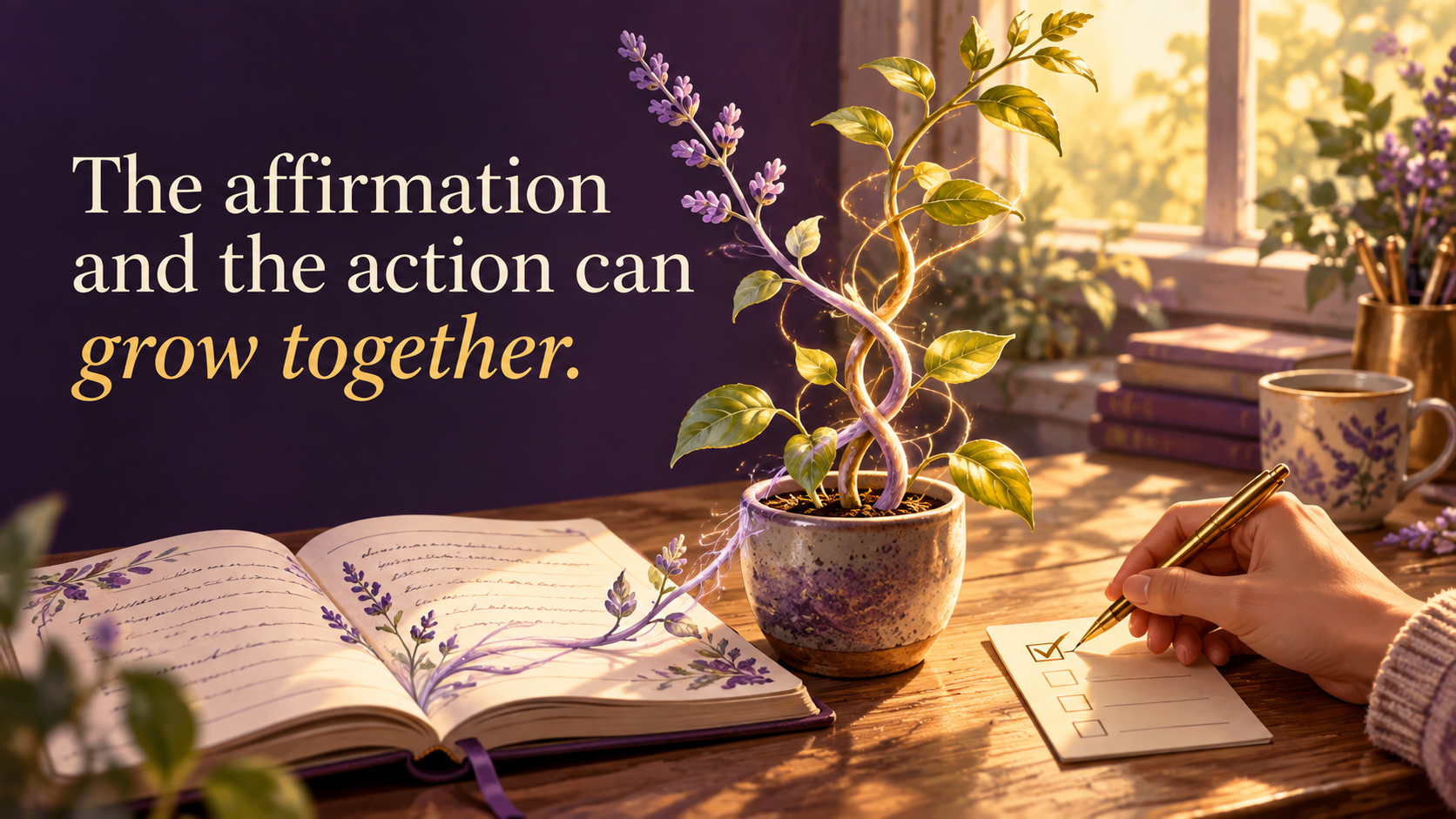
The affirmation and the action can grow together.
What self-talk research tells us
Researchers have studied how the words people use during stressful moments affect their responses.
Across seven studies involving 585 people, participants who used their own names or non-first-person language while reflecting on stress showed benefits that included less distress and, in some situations, better performance. Picture the difference between “I’m going to blow this” and “Tracy, you’re nervous. Take a breath and begin.”
Researchers have also looked at self-talk during sports. A review of 32 studies found a moderate positive effect on performance, and interventions that included self-talk training did better than those without that training. A basketball court isn’t the same as an anxious Tuesday afternoon, of course. But the findings support a principle I love: the words we practice can help direct what we do.
That’s why I don’t think affirmations are silly.
I think the words we repeat deserve at least as much attention as the messages we’re willing to put on a billboard.
Affirming who you’re becoming
When you’ve spent years saying, “I never finish anything,” a new sentence may feel unfamiliar.
Of course it does. You haven’t practiced it as often.
You might begin with:
“I am a woman who follows through.”
Then you follow through on one small thing. You reply to the email. You put the appointment in your calendar. You finish the first paragraph.
The next day, you say it again. And you follow through on something else.
Maybe your brain argues at first: “Oh, really? Should we discuss the laundry?”
You don’t have to hold a formal debate with your laundry. You’re practicing a new response and gathering new experiences. The affirmation reminds you what you’re choosing; your actions give you another reason to keep choosing it.

Here are some other examples:
“I’m capable of making decisions.”
Then choose one thing without conducting a full congressional hearing in your head.
“I can handle discomfort.”
Then stay with a hard task for two minutes before deciding what comes next.
“I’m learning to trust myself.”
Then notice a decision you made that turned out okay.
“I’m worthy of being heard.”
Then say the thought you were about to swallow.
None of this requires perfection. It requires practice.
For the woman with anxiety
Anxiety is exceptionally good at writing scripts.
Something will go wrong.
You won’t be able to handle it.
Everyone will notice.
You need certainty before you move.
When anxiety repeats those lines, you can repeat something else:
“I can feel anxious and still make a choice.”
“I have handled hard moments before.”
“I don’t need certainty to take one reasonable step.”
“My fear gets a voice. It doesn’t get the only vote.”
You may still feel anxious after saying them. An affirmation isn’t a button that switches off your nervous system.
But it can help you enter the moment with a different script.
Instead of spending all your energy trying to prove you’ll never feel fear, you can remind yourself that fear and capability are allowed to exist in the same person.
They have in you before.
For the woman with ADHD
ADHD can hand you plenty of discouraging experiences to misinterpret.
You meant to start at nine. Suddenly it’s eleven. You lost the paper. You forgot the thing. You started six other things while looking for the thing you needed to start the original thing.
And then the self-talk arrives:
“I’m lazy.”
“I’m a mess.”
“I never stick with anything.”
Let’s be careful about turning a struggle with attention or starting into a verdict on your character.
Try words that support the person you want to be and the practical support you need:
“I know how to make this easier to start.”
“I can return when I get distracted.”
“I’m becoming someone who builds systems that work for her brain.”
“One step counts.”
Notice what those affirmations leave room for: your sticky notes, your alarms, the shoes you put by the door, and whatever beautifully ridiculous setup makes tomorrow’s task ten times easier.
Words and systems can work together. I’m a big believer in giving tomorrow’s version of you every possible advantage.

For the woman who can’t decide
Indecision often sounds like responsibility.
I should research one more option.
I need to be sure.
What if I choose wrong?
Sometimes research is useful.
Sometimes you’re trying to reach a level of certainty no decision can offer.
That’s when I’d practice:
“I trust myself to make a thoughtful choice.”
“I can make a decision and respond to what happens next.”
“A choice doesn’t have to be perfect to move my life forward.”
Then set a reasonable limit, choose, and let yourself experience being a person who can make decisions.
That last part matters. You can’t build trust in your ability to choose if you never let yourself choose.
What if you don’t believe the affirmation yet?
Say it anyway if it speaks to who you want to become.
That’s my honest answer.
You don’t have to wake up feeling confident before you practice confident words. You don’t have to feel completely lovable before you say you’re worthy of love. You don’t have to feel brave before you remind yourself that you’re brave enough to try.
You can choose an affirmation as a direction.
Then repeat it. Write it where you’ll see it. Say it before the meeting, when you start the project, or after a day that didn’t go how you hoped. Let it call you back to the identity you’re building.
And pay attention to the experiences that support it. If you say, “I’m someone who keeps going,” notice the times you return after a setback. Those count, even if you returned grumbling and holding coffee.
Especially then, perhaps.
Make the words your own
I don’t want to hand you a list of fifty polished affirmations and tell you to say them all before breakfast. We both have lives.
Pick one sentence that meets a real need.
If you’ve been telling yourself, “I’m always behind,” perhaps your sentence is:
“I can begin from where I am.”
If you’ve been waiting to feel confident:
“I’m becoming a woman who shows up before she feels ready.”
If your anxiety keeps predicting disaster:
“I can meet this moment without solving every future moment.”
If you’re exhausted from judging yourself:
“I deserve the same patience I give other people.”
Say it in your own voice. Say it with a little attitude if that helps. Put it on a sticky note, make it your phone background, or say it while you’re putting your shoes on.
Then look for one action that goes with it.
Not because words are powerless without a task attached, but because words can help you take the steps that make a new story part of your life.

Questions you might be asking
Can affirmations really “rewire” your brain?
I believe repeated words can be part of changing the patterns we practice, especially when we pair them with new ways of responding and acting. The brain can change through learning and experience, and studies of psychological treatment have measured brain changes alongside improvements. Research on affirmations also shows effects in brain systems involved in self-related thought and value. What researchers haven’t established is a precise claim such as “repeat this sentence for 30 days and it will form this specific neural pathway.”
Isn’t “fake it till you make it” dishonest?
It depends on what you mean by fake. I’m talking about rehearsal. If you say, “I’m a confident speaker,” while feeling nervous, you’re practicing the identity you’re growing into. You can acknowledge the nerves and still choose how you’ll speak and act.
Do I have to say affirmations out loud?
You can. You can also write them or say them silently. The studies I’ve discussed used different exercises, so I won’t claim that speaking aloud is the one proven way. If hearing your own voice makes the words more memorable or helps you pause and focus, use it.
What if I still have negative thoughts?
Then you’re human. The aim isn’t to eliminate every anxious or self-critical thought. The aim is to give yourself another sentence to reach for when an old one appears.
Can this replace therapy, ADHD support, or practical tools?
No. Affirmations can be part of how you support yourself. You may also need treatment, medication, accommodations, community, rest, or a better system for managing the day. Using more than one tool is allowed, friend. It’s often wise.
Does abracadabra actually mean “I create as I speak”?
We can’t present that as a verified translation. The word’s origin remains uncertain, and the popular Aramaic explanation has substantial problems. I’m borrowing “I create as I speak” as a meaningful idea, while being honest about where the history stops.
The words I want you to take with you
What you say to yourself today doesn’t have to be what you’ve always said.
You can speak to the woman you’re becoming before you feel like her.
You can practice courage while you’re nervous.
You can practice trust while you’re uncertain.
You can practice kindness while you’re still learning how to stop tearing yourself down.
Then you can take one step that matches the words.
And another.
No, abracadabra doesn’t give us a scientifically verified ancient instruction manual for doing that. But “I create as I speak” is still a reminder I want to keep.
Your words can help shape what you practice. What you practice can shape what you do. And what you do, again and again, can change a life.
Start with one sentence.
What do you want to begin saying about yourself?
Courage Challenge of the Week: Say It, Then Show It
Choose one belief you want to practice this week. Maybe it’s “I’m brave enough to begin,” “I can trust myself to decide,” or “I’m a woman who follows through.”
Say it out loud each morning—even if your brain responds, “Oh, really?” Your brain is allowed to have opinions. It doesn’t get to run the whole meeting.
Then take one tiny action that matches your words. Open the document. Make the decision. Send the message. Come back to a task after getting distracted.
At the end of the day, write down what you did. Do that for seven days.
You’re giving your new words something to grow alongside: your own evidence.
Final Thought
You’ve spent years hearing certain stories about yourself. Some came from other people. Some came from hard moments. And some you’ve repeated so often they started to sound like facts.
You’re allowed to choose new words now. Say them before they feel natural. Practice them when things go well, and especially when they don’t. Let each small action give your new story a little more room to grow.
You’re still becoming, friend. Speak to yourself like the woman you’re becoming deserves to be heard.
Brave Looks Good on You.