
By Tracy Gray | Alpha with Tracy Lynn Gray
Anxiety loves a plan.
Not a normal plan, mind you.
Anxiety wants a plan for the plan, a backup plan for the backup plan, and a color-coded emergency flowchart in case Brenda from accounting uses a weird tone in an email.
It wants to know what’s going to happen, how everyone will react, whether you’ll be okay, whether they’ll be okay, how long the discomfort will last, what the test result will say, and whether that one tiny sensation in your left elbow means something catastrophic or whether you simply slept like a rotisserie chicken again.
Anxiety doesn’t just want information. It wants a guarantee.
And because guarantees feel like safety, control can start looking like recovery. You may tell yourself that if you think hard enough, research long enough, rehearse every conversation, prevent every mistake, and stay alert for every possible threat, you’ll finally feel calm.
This isn’t some tiny, obscure struggle, either. The World Health Organization estimates that 470 million people worldwide were living with an anxiety disorder in 2023. That’s a whole lot of human brains trying to turn “maybe” into “definitely” before breakfast.
But here’s the rude little plot twist: the more you demand certainty before you allow yourself to feel safe, the more power anxiety gets.
Real recovery isn’t becoming so prepared that nothing can surprise you. It’s learning that you can handle life even when it does.
Control Feels Like Safety—Until It Becomes a Full-Time Job
There’s nothing wrong with wanting control. Control is useful. We use it to make appointments, pay bills, wear seat belts, set boundaries, and avoid putting a red sweater in a load of white laundry unless we’re emotionally prepared to own seventeen pink towels.
Healthy control helps you respond to reality. Anxiety-driven control tries to eliminate uncertainty from reality.
That second job is impossible, but anxiety is nothing if not ambitious.
When anxiety is running the meeting, control can look like:
• Checking your body repeatedly for symptoms
• Googling the same question until you find an answer that feels safe enough
• Replaying conversations to make sure you didn’t say something wrong
• Asking for reassurance, feeling better briefly, and then needing reassurance again
• Overpreparing for ordinary situations
• Avoiding decisions because you can’t guarantee the outcome
• Trying to manage other people’s feelings so nobody becomes upset with you
• Waiting to act until you feel completely calm, confident, or certain
These behaviors aren’t proof that you’re dramatic, needy, weak, or secretly terrible at adulthood. They’re attempts to regulate fear. They make sense. They may even work for a minute.
And that’s precisely why they’re so sticky.
Research reality: Anxiety is incredibly common.
The National Institute of Mental Health reports that about one-third of U.S. adolescents and adults experience an anxiety disorder at some point in their lives. You’re not uniquely broken. You’re human, and your threat-detection system has gotten a little too enthusiastic about its job.
The Anxiety-Control Loop
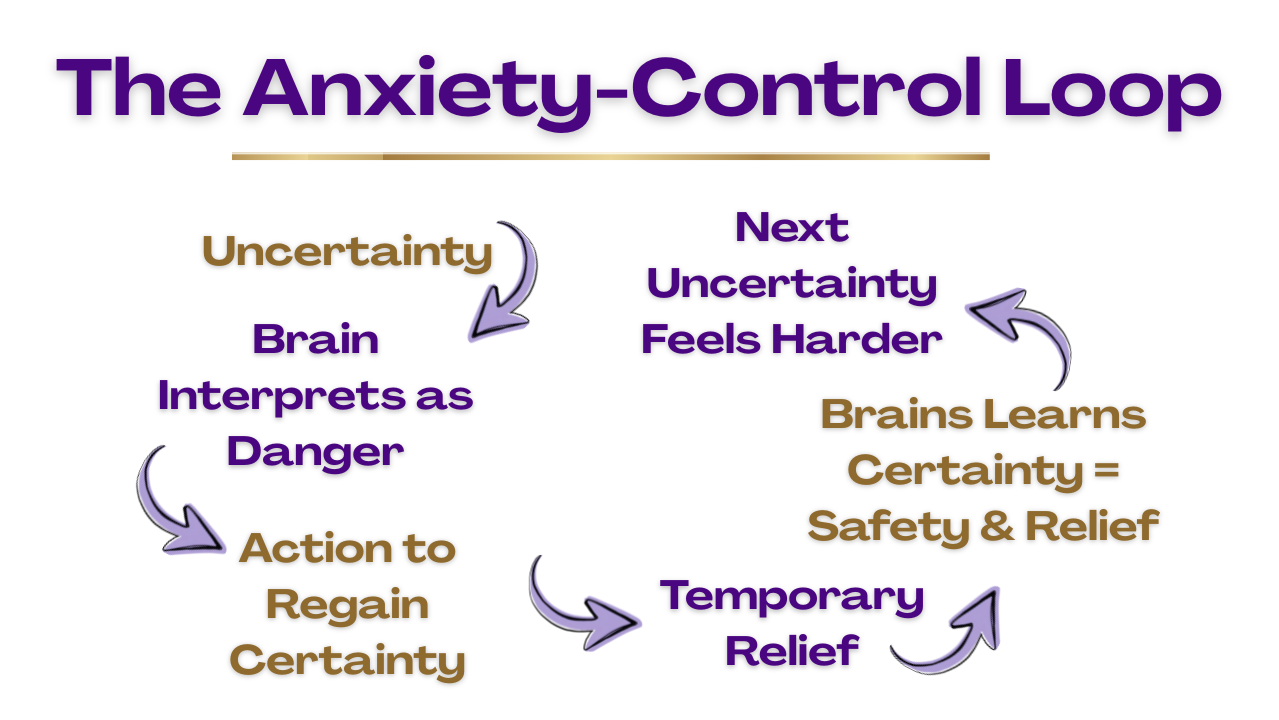
Anxiety-driven control usually follows a predictable loop:
Something feels uncertain. You notice a sensation, decision, silence, risk, or unanswered question.
Your brain interprets uncertainty as danger. Not possible danger. Immediate, flashing-lights, everybody-report-to-your-stations danger.
You do something to regain certainty. You check, avoid, research, rehearse, seek reassurance, or mentally review the situation for the four-hundredth time.
You feel temporary relief. Ahhh. The fire alarm quiets down.
Your brain learns the wrong lesson. It concludes, “Good thing we did all that. The uncertainty must have been dangerous.”
The next uncertain moment feels even harder. Now your brain wants the same ritual faster, longer, and with supporting documentation.
The behavior isn’t the villain. The lesson your brain learns from it is the problem.
Every time you treat uncertainty like an emergency that must be neutralized, you reinforce the belief that you can’t tolerate not knowing. You may gain ten minutes of relief while quietly making tomorrow’s anxiety louder.
Your Brain Isn’t Trying to Ruin Your Life
Your anxious brain isn’t malicious. It’s protective. It’s the world’s most intense unpaid security guard—deeply committed, wildly overcaffeinated, and suspicious of absolutely everyone.
Uncertainty matters to the brain because an unclear threat is harder to predict and prepare for. Neuroscience research has described anxiety as closely connected to anticipating an uncertain future threat. When the outcome is unknown, the brain may keep scanning, simulating, and preparing because it doesn’t know when it’s safe to stand down.
In plain English: your brain thinks more thinking will eventually purchase certainty.
Unfortunately, certainty isn’t for sale. Anxiety will still keep you at the register, digging through the bottom of your purse for exact change.
Research reality: Uncertainty is a central part of anxiety—not a personal failure.
A major neuroscience review concluded that uncertainty about a possible future threat contributes to anxiety because it interferes with our ability to predict, avoid, or reduce that threat. In other words, the discomfort you feel around “not knowing” has a real brain-based explanation.
Source: Grupe and Nitschke, Nature Reviews Neuroscience
What Letting Go Actually Means
Let’s clear something up, because “let go” can sound like the kind of advice printed on a decorative pillow by someone who has never met your nervous system.
Letting go doesn’t mean:
• You stop caring
• You ignore real problems
• You never plan or prepare
• You trust everyone blindly
• You pretend painful outcomes can’t happen
• You toss your responsibilities into the ocean and whisper, “The universe will handle it”
Letting go means you stop trying to control what was never fully yours to control.
You still take wise action. You still gather reasonable information. You still make the appointment, have the conversation, build the budget, lock the door, and bring an umbrella when the weather app says there’s a 90% chance of rain.
But you stop demanding that your actions deliver a guaranteed outcome.
That’s not carelessness. That’s emotional maturity with better boundaries.
The Difference Between Power and Control
Control says, “I need to make sure nothing bad happens.”
Power says, “I’ll respond to what happens.”
Control says, “I can’t move until I know.”
Power says, “I know enough to take the next right step.”
Control says, “Everyone must understand me, approve of me, and react well.”
Power says, “I can be clear, kind, and honest. Their response belongs to them.”
Control is outcome-dependent. Power is values-dependent.
And that distinction changes everything, because outcomes are often outside your authority. Your next brave action isn’t.
Why Acceptance Is an Active Skill
Acceptance doesn’t mean liking what’s happening. It means acknowledging what’s already true so you can choose your response without wasting half your energy arguing with reality.
You can accept that you feel anxious without agreeing with every anxious thought. You can accept that a conversation may be uncomfortable without rehearsing all 47 possible versions of it. You can accept that you don’t know the future without appointing yourself Director of Imaginary Disaster Forecasting.
Acceptance sounds like:
• “I don’t know how this will turn out.”
• “I don’t like this feeling, but I can make room for it.”
• “My mind is asking for a guarantee I can’t give it.”
• “I can be uncertain and still take one useful step.”
• “I don’t have to solve a future that hasn’t happened.”
This is not passive. Staying present with uncertainty without immediately performing your usual control ritual requires courage, repetition, and approximately twelve metric tons of patience.
Research reality: Practicing a different relationship with anxiety can help.
In a randomized controlled trial of 93 adults with generalized anxiety disorder, an eight-week mindfulness-based program produced greater improvement than an active stress-education comparison on several measures of anxiety and reduced anxiety and distress during a laboratory stress challenge. The goal wasn’t to control every thought; it was to change how participants related and responded to their experience.
Source: Hoge et al., Journal of Clinical Psychiatry
How to Practice Letting Go Without Losing Your Mind
You don’t have to release every control strategy by sunset. Please don’t turn letting go into another impossible standard you can fail at. Anxiety would love that little rebrand.
Start small.
1. Name What You’re Actually Trying to Control
Ask yourself: “What am I trying to guarantee right now?”
Maybe you’re trying to guarantee that nobody will be disappointed, that the medical test will be normal, that you won’t feel embarrassed, or that you’ll make the perfect decision.
Naming the guarantee exposes the illusion. You can influence many things. You can’t guarantee most of them.
2. Separate What’s Yours From What Isn’t
Make two quick lists.
Mine: my words, my effort, my boundaries, my preparation, my next step, whether I ask for help.
Not mine: other people’s reactions, perfect certainty, the past, every possible future, whether discomfort appears.
Your energy belongs in the first list. The second list is where anxiety has been running an unauthorized side business.
3. Delay the Control Ritual
If you usually check, Google, ask for reassurance, or replay the event immediately, try waiting ten minutes first. You’re not promising you’ll never do it. You’re creating space between the feeling and the reaction.
During those ten minutes, notice the urge rise and fall. Let your nervous system discover that discomfort can move without being obeyed.
If ten minutes feels enormous, start with two. We’re building capacity here, not auditioning for the Anxiety Olympics.
4. Choose “Useful Enough” Instead of Perfect Certainty
Ask: “Do I have enough information to take the next reasonable step?”
Not the final step. Not the flawless step. Not the step that comes with a divine notarized guarantee and a marching band.
Just the next reasonable one.
5. Let the Feeling Ride Along
You don’t have to eliminate anxiety before you act. You can send the email while anxious. Attend the appointment while anxious. Set the boundary while your voice shakes. Make the decision while part of your brain is still filing objections.
Anxiety can come along. It just doesn’t get to drive.
6. Practice Recovery Language
The words you use matter because they can either feed the demand for certainty or build your tolerance for uncertainty.
• Instead of “I need to know,” try “I’d like to know, but I can tolerate not knowing yet.”
• Instead of “What if I can’t handle it?” try “If it happens, I’ll handle the part in front of me.”
• Instead of “I have to calm down,” try “I can feel anxious and still be safe enough in this moment.”
• Instead of “I need the perfect choice,” try “I’m making the best choice I can with what I know today.”
7. Measure Courage, Not Comfort
If success means “I felt no anxiety,” you’ll overlook your progress every time anxiety shows up.
Try measuring something you can actually control:
• Did I take the step?
• Did I reduce one round of checking?
• Did I allow uncertainty for five minutes longer?
• Did I act according to my values instead of my fear?
• Did I speak to myself with compassion instead of criticism?
That’s recovery. Not a life where uncertainty disappears, but a life where uncertainty no longer gets veto power.
But What If Something Bad Really Does Happen?
This is the question underneath almost every control strategy.
And the honest answer is: sometimes hard things do happen.
I’m not going to insult you with a sparkly promise that everything always works out exactly the way you want. Life can be painful, unfair, and deeply inconvenient. People disappoint us. Bodies do strange things. Plans fall apart. Sometimes Tuesday shows up carrying absolute nonsense.
Letting go isn’t based on the belief that nothing bad will happen.
It’s based on the growing evidence that you don’t have to pre-suffer every possible future in order to survive the one that actually arrives.
You’ve handled uncertainty before. You’ve adapted. You’ve asked for help. You’ve made decisions without complete information. You’ve gotten through days you once thought would flatten you.
Your safety doesn’t come from predicting everything. A deeper kind of safety grows when you trust your ability to meet reality one moment at a time.
The REAL Power Move
The real power move isn’t controlling your thoughts, your future, your body, other people, or every outcome.
It’s deciding that your life won’t remain on hold while anxiety waits for guarantees.
It’s releasing the job of Future Emergency Manager and returning to the life that’s happening right now.
It’s saying:
• “I can prepare without obsessing.”
• “I can care without controlling.”
• “I can feel uncertainty without treating it like danger.”
• “I can’t choose every outcome, but I can choose how I show up.”
You don’t need perfect certainty to move forward.
You need enough willingness to take one brave step while uncertainty is still in the room—being loud, touching things it shouldn’t, and generally acting like it pays rent.
Let it be there.
Then take the step anyway.
Questions & Answers
Is letting go the same as giving up?
No. Giving up means abandoning what matters. Letting go means releasing your demand to control every detail and outcome while continuing to act on what matters. You’re not surrendering your agency. You’re putting it where it can actually do some good.
How do I know whether I’m planning or anxiously controlling?
Look at the function, not just the behavior. Healthy planning usually has a stopping point and leads to action. Anxiety-driven control tends to repeat, multiply, and delay action because no amount of preparation feels sufficient. If you’ve gathered the same information six ways and still feel compelled to keep going, anxiety may be looking for certainty rather than useful facts.
What if reassurance is the only thing that calms me down?
Reassurance can feel genuinely calming, and seeking support isn’t wrong. The problem is when reassurance becomes a ritual you need repeatedly because the relief doesn’t last. Try reducing it gradually: delay the request, ask once instead of several times, or write down the answer you already received and practice tolerating the urge to ask again. A therapist can help if this pattern feels overwhelming.
Am I supposed to accept every anxious thought as true?
Absolutely not. Acceptance means allowing the thought to exist without wrestling with it or automatically obeying it. You can say, “My mind is telling me this will be a disaster,” without deciding the thought is a prediction, instruction, or breaking-news alert.
Can I still take precautions and work on anxiety recovery?
Of course. Recovery isn’t reckless. Appropriate medical care, safety precautions, boundaries, financial planning, and preparation are all reasonable. The question is whether the action is proportionate and useful—or whether it’s an endless attempt to make uncertainty disappear.
What if letting go makes my anxiety worse at first?
That can happen. When you stop performing a familiar safety behavior, your anxiety may protest because your brain expects the old routine. A temporary increase in discomfort doesn’t necessarily mean you’re doing something wrong. Start small, move gradually, and seek professional support if the distress is severe, persistent, or interfering with daily life.
When should I get professional help?
Consider talking with a qualified mental health professional if anxiety is disrupting your work, sleep, relationships, health decisions, or daily functioning; if avoidance is shrinking your life; or if you feel stuck in checking, reassurance, panic, or obsessive thought loops. You don’t have to wait until things become unbearable to deserve support.
A Final Reminder
You’re not failing because you want certainty. You’re not weak because letting go feels hard. Your brain learned that control might protect you, and it has probably practiced that lesson for a long time.
You can teach it something new.
You can learn that uncertainty is uncomfortable without always being dangerous. You can learn that anxiety can rise without running the show. You can learn that courage isn’t the absence of fear—it’s the refusal to let fear make every decision.
You don’t have to control the whole road.
You only have to choose your next brave step.
Research Sources
• National Institute of Mental Health. Anxiety Disorders.
• World Health Organization. Anxiety disorders fact sheet.
The Anxious Alpha | theanxiousalpha.com
