
By Tracy Lynn Gray
Has anyone in the history of being told to “calm down” ever responded with, “Oh, excellent suggestion. Hadn’t considered that. All better now”?
Because I’d love to meet her.
Usually, “calm down” lands somewhere between “just stop worrying” and “have you tried being less stressed?”
Thanks, dude. Revolutionary stuff.
But sometimes the person issuing that command isn’t your husband, your coworker, or some wildly unhelpful stranger.
It’s you.
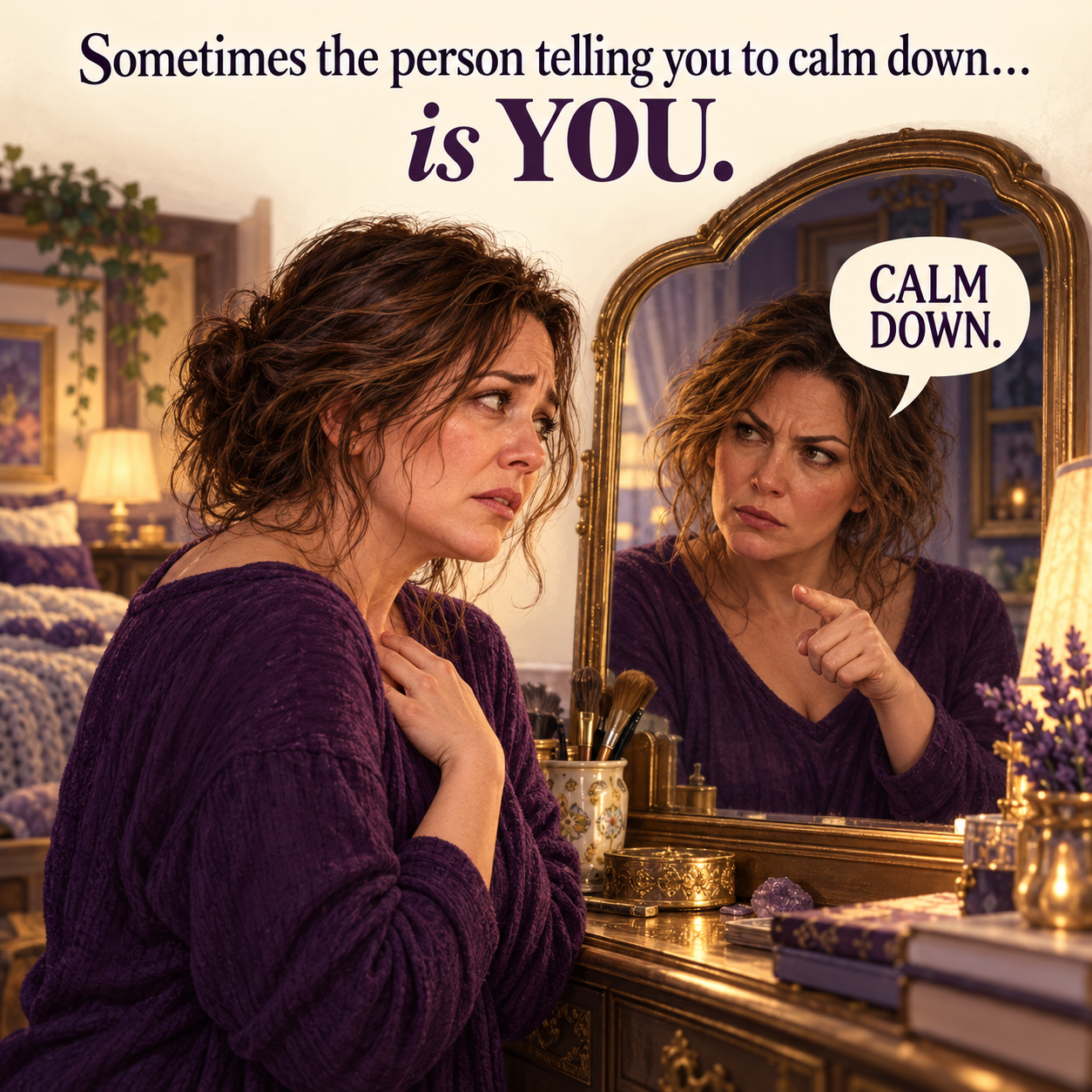
You’re sitting there with your shoulders up by your earrings, seventeen tabs open in your brain, and a stomach that’s apparently auditioning for competitive gymnastics.
And you’re thinking: “I need to calm down. Why can’t I calm down? What’s wrong with me?”
Now you’re anxious—and frustrated with yourself for being anxious.
Y’all, that’s a lousy two-for-one deal.
Here’s something different to try: stop making calm the requirement. Give yourself support, then choose your next step.
When calm becomes another assignment
Wanting relief makes sense. Anxiety can feel exhausting, uncomfortable, and deeply inconvenient. Nobody’s putting “spiral in the grocery store” on her vision board.
But consider what happens when your internal rule becomes: “I can’t do anything until this feeling goes away.”
You check whether you’re calmer. You try another technique. You check again. You wonder whether you’re doing it wrong.
Before long, you’re supervising your feelings like a suspicious manager watching an employee take a bathroom break.
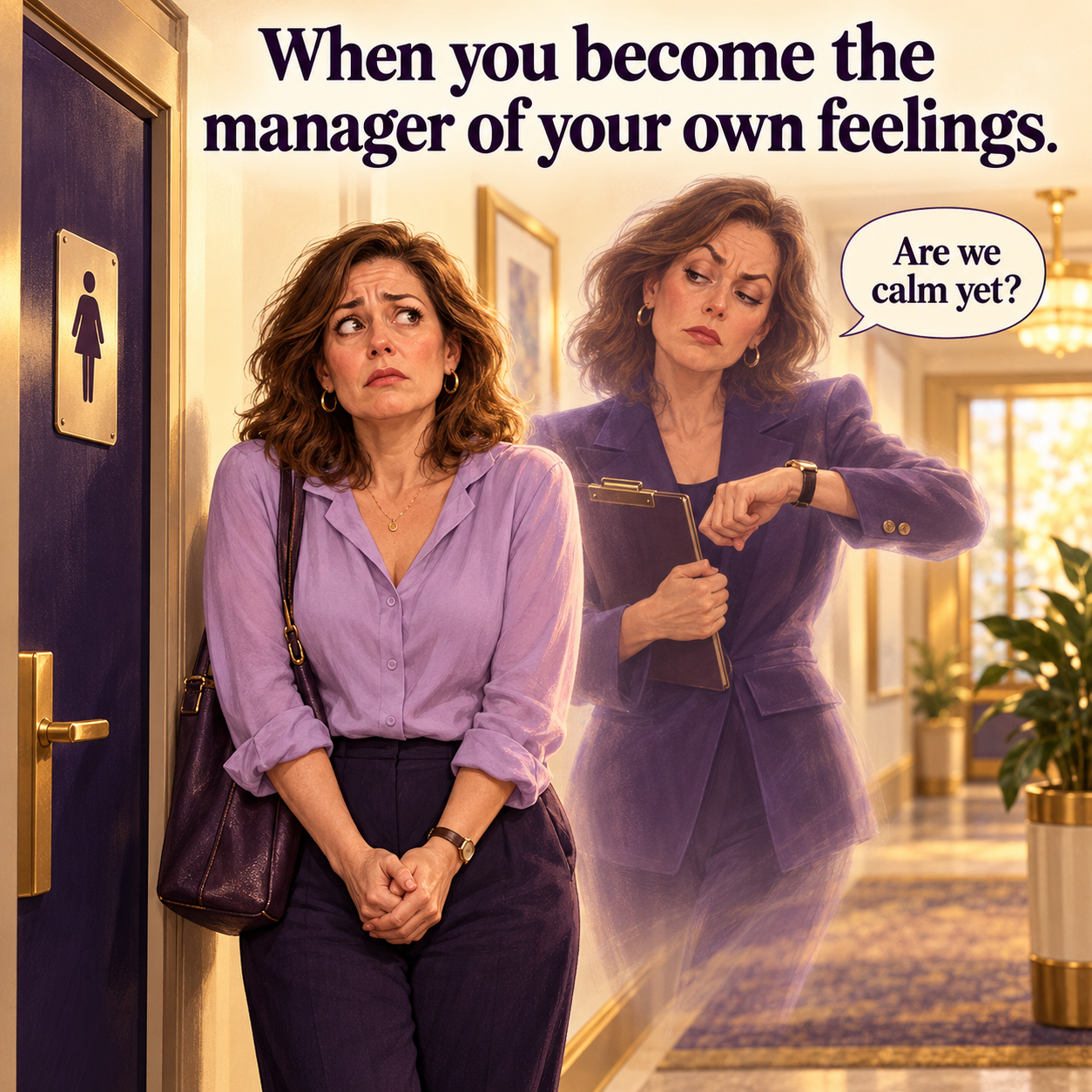
“Are we calm yet? How about now? What exactly is taking so long?”
That’s a lot of pressure to put on an already difficult moment.
You can want relief without turning relief into a test you have to pass before you’re allowed to live your life.
Try a different question
Instead of asking, “How do I make this stop immediately?” try:
“What would help me through the next few minutes?”
That question leaves room for more than one answer.
Maybe you need less noise. Maybe you need to sit down. Maybe you need support, a clearer plan, or permission to leave a nonessential task for tomorrow.
Maybe you can take one small step while the nerves tag along.
This approach fits a principle used in acceptance and commitment therapy, or ACT: making room for difficult feelings while choosing actions connected to what matters to you. Acceptance means acknowledging what’s here; it doesn’t mean liking it or letting it make every decision. [1]
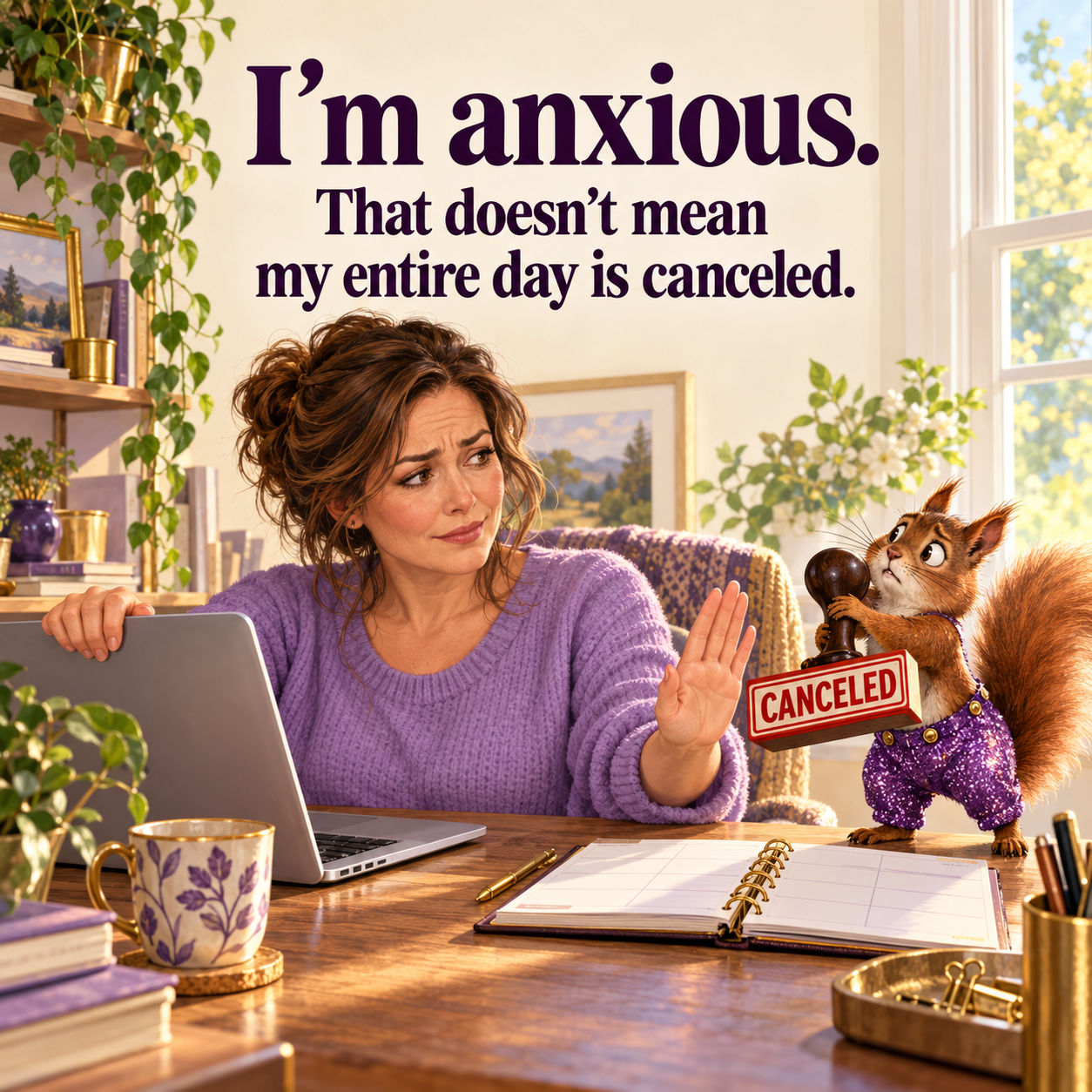
You can say, “I’m anxious,” without adding, “Therefore, my entire day is canceled.”
1. Name what’s happening without insulting yourself
Try a plain description:
“I’m noticing anxiety.”
“I’m overwhelmed by how much is happening.”
“I’m having the thought that I’ll mess this up.”
Compare that with: “I’m ridiculous. I always do this. Why can’t I be normal?”
One describes an experience. The other turns it into a character assassination.
You’re having a hard moment. You don’t need to prosecute yourself over it.
If humor helps, picture Kevin, the glitter-pants squirrel, arriving with his Potential Disasters clipboard.
“We have concerns about the email, the appointment, and that weird look someone gave us in 2011.”
“Thank you, Kevin. We’re handling the email. The 2011 investigation is closed.”

You’re allowed to acknowledge your mind’s commentary without attending its entire presentation.
2. Give yourself something present and concrete
When your thoughts are sprinting into tomorrow, gently bring some attention to where you are now.
Feel your feet against the floor. Notice the chair supporting you. Look around and name three things you can see. Listen for a sound in the room.
If comfortable, let your breathing be gentle and unforced. If focusing on your breath feels unpleasant, use sights, sounds, or touch instead. Present-focused practices help some people manage anxiety; you can choose an anchor that suits you. [2]
This doesn’t need to become a twelve-step ceremony involving a special candle and a Himalayan singing bowl.
Your kitchen chair will do.
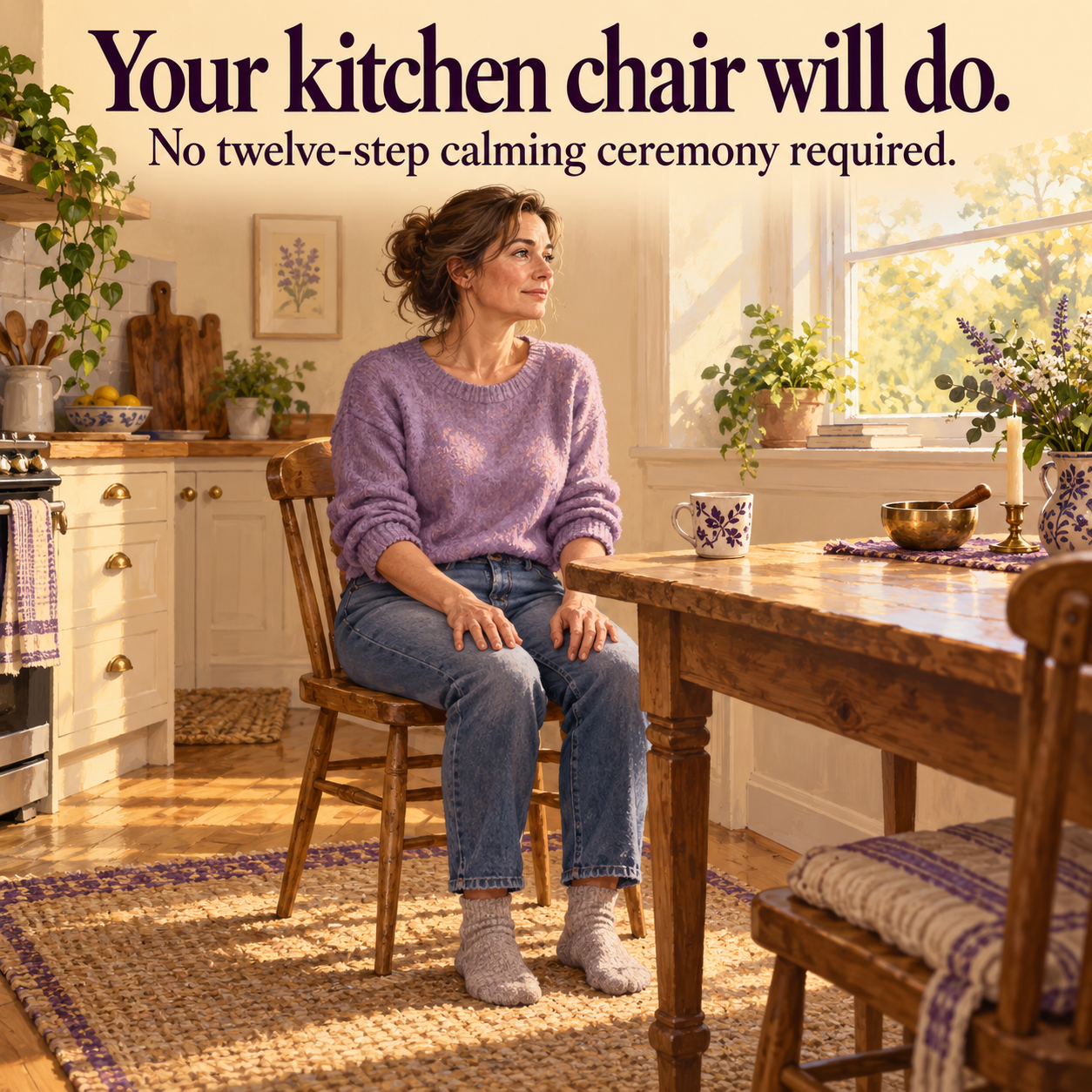
You’re giving your attention somewhere to land. You don’t have to feel instantly peaceful for the pause to count.
3. Ask what would actually support you
Before you demand more effort, check the situation.
Are three people talking to you while your phone pings and the television blares? Turn something off or step somewhere quieter.
Are you overwhelmed by a task you don’t understand? Write down the first question you need answered.
Are you exhausted? Consider rest or a smaller plan.
Do you need someone with you? Ask.
For the woman juggling anxiety, ADHD, and a thousand competing demands, “try harder” may be the least useful item on the menu. Sometimes the kindest move is making the situation easier to navigate.
You don’t get extra credit for answering an email while the blender’s running and someone’s asking where the tape is.
Also, why is the tape always missing?

4. Choose one small, meaningful next step
Once you’ve given yourself a little support, ask:
“What’s one manageable thing I can choose here?”
If you’re anxious about an email, open the draft and write the first sentence.
If you’re nervous about an appointment, put the address where you can find it.
If you need a boundary, begin with: “Let me check what I can realistically take on.”
If you’re depleted, your next step might be closing the laptop and resting.
The step should fit your capacity and the situation. It doesn’t have to impress anybody.
Especially Kevin. He’s wearing glitter pants and carrying a clipboard. His approval process is questionable.

You can let your feelings be present while you make a choice. That choice can be action, support, or rest.
Let the win be bigger than “I felt calm”
Afterward, try asking: “How did I care for myself? What did I choose?”
Maybe you were still nervous, but you asked the question.
Maybe you were still overwhelmed, but you reduced the noise.
Maybe you didn’t finish the task, but you made it easier to begin tomorrow.
Those are worth noticing.
“I handled that with care” deserves a place beside “I felt better.”
Q&A: But what if…?
Does this mean I should stop using calming techniques?
Keep the tools that help you. Breathing exercises, grounding, and relaxation can be useful. The shift is giving yourself permission to benefit from them without requiring them to erase every uncomfortable feeling before you move on. [2]
Your favorite calming playlist doesn’t need to be fired. We’re just taking “achieve immediate serenity” out of its job description.
How can I accept anxiety when I hate feeling it?
Start with: “I don’t like this, and it’s what I’m feeling right now.”
You don’t have to celebrate it. You’re acknowledging the experience so you can decide how to respond. ACT uses this distinction to help people act on their values even when difficult feelings show up. [1]
What if I’m too overwhelmed to take a step?
Make support the step. Sit somewhere quieter, ask someone to stay with you, or reduce the immediate demand.
There’s no courage quota you have to meet today. You can return to the task when you have more support or capacity.
What if I try this and I’m still anxious?
You haven’t failed. Notice whether you responded with a little more kindness or made one useful choice.
If anxiety keeps disrupting sleep, relationships, work, or everyday life, reach out to a qualified mental health professional. You deserve support that fits what you’re experiencing. [2]
And don’t automatically label new or concerning physical symptoms as anxiety. Get medical advice when you’re unsure. [2]
Isn’t taking action while anxious just pushing through?
It can become that if you ignore your limits or force yourself into something unsafe or overwhelming.
The invitation here is to choose a small, manageable response in an ordinary, safe situation. You can adjust, pause, ask for help, or rest. Your next step should include care for you.
Courage Challenge of the Week ⭐

This week, choose one everyday, low-stakes moment when you catch yourself thinking, “I have to calm down first.”
Then try this:
1. Name it: “I’m noticing anxiety.”
2. Anchor: Feel your feet on the floor or notice three things around you.
3. Support: Ask, “What would make this moment more manageable?”
4. Choose: Take one tiny step toward something that matters to you.
Maybe you send a simple reply, ask for clarification, or give yourself the break you keep postponing.
Afterward, finish this sentence:
“I felt ______, and I chose ______.”
That’s your evidence. No perfectly peaceful ending required. No bonus points for making it harder.
Final Thought
Girl, you don’t have to turn yourself into a serene little woodland creature before you’re allowed to participate in your own life.
You can be a woman with a busy mind, shaky confidence, and a squirrel conducting an unauthorized risk assessment—and still make a thoughtful choice.
Give yourself something steadier than another demand to calm down.
Give yourself kindness. Give yourself support. Give yourself a next step small enough to take.
Courage can look like sending the message. It can look like asking for help. It can look like saying, “That’s enough for today,” and meaning it.
You don’t have to feel perfectly calm to treat yourself like someone worth caring for.

Sources
[1] U.S. Department of Veterans Affairs, “PTSD Bytes #19: Acceptance and Commitment Therapy.” https://news.va.gov/109987/ptsd-bytes-19-acceptance-and-commitment-therapy/
[2] NHS Every Mind Matters, “Managing anxiety.” https://www.nhs.uk/every-mind-matters/mental-health-issues/anxiety/
