You want to write the book.
You want to apply for the opportunity, launch the business, finish the course, or make progress on the idea that keeps tugging at you.
You care. Sometimes you care so much that you think about it while you’re doing seventeen other things.
And then you finally get a little time to work on it.
So naturally, you organize your desktop.
Check your email.
Decide the kitchen drawer has been operating without adequate supervision.
Somewhere in your brain, Kevin the glitter-pants squirrel has called an emergency meeting.
“Before we begin the meaningful work, we need to address these loose batteries.”

Three hours later, the batteries have a home.
Your dream still doesn’t.
And now you’re wondering what’s wrong with you.
Because surely, if you actually wanted something, you’d do it.
Right?
Wanting something and being able to start it are different experiences. And when a task matters deeply, caring can add weight to the very thing you’re trying to move toward.
That’s the confusing part.
When a task becomes more than a task
An ordinary task might ask you to do something.
A meaningful task can feel like it’s asking you to prove something.
Writing a paragraph becomes:
Am I actually a writer?
Submitting an application becomes:
What if they decide I’m not good enough?
Starting your business becomes:
What if I give this everything I’ve got and it still doesn’t work?
Now you’re sitting in front of a document that appears to contain three sentences and an evaluation of your entire existence.
No wonder checking the weather suddenly feels urgent.
At least the weather app isn’t asking whether you’ve wasted your potential.

When something matters, the work can carry hope, uncertainty, expectations, and the possibility of disappointment. You might want the outcome while feeling reluctant to experience everything that comes with pursuing it.
Those feelings can exist together.
You can care about something and find it hard to approach.
Avoidance can give you relief—and a bigger problem later
Let’s say you open the project and immediately feel unsure.
You don’t know where to begin. You’re worried it won’t be good. You remember how much there is to do.
Then you check your messages.
For a moment, the uncomfortable feeling eases. You’ve moved to something familiar. Something with a clearer next step.
Your brain didn’t necessarily select the thing that mattered most.
It selected something that felt easier to deal with right then.
Unfortunately, the meaningful task is still waiting.
Now it also comes with guilt.
And perhaps a deadline.
And Kevin, who has prepared a presentation titled “How This Has Become Considerably Worse.”

Avoidance can relieve discomfort in the moment while making the next attempt feel heavier. Understanding that pattern gives you somewhere useful to intervene.
Calling yourself lazy usually just adds another unpleasant feeling to the pile.
The pile has enough furniture.
Sometimes the task is simply too vague
Before you investigate your deepest fears, look at the instructions you’ve given yourself.
“Work on the website.”
“Get my life together.”
“Write the book.”
Y’all. Those aren’t next steps. Those are entire departments.
A task can be important and still be poorly defined.
You might know what you want eventually without knowing what your hands are supposed to do next.
For women navigating ADHD, executive dysfunction, anxiety, or plain old overload, that gap can be especially frustrating. Caring doesn’t automatically supply a starting point, enough energy, or a workable sequence.
Try replacing the project name with a visible action.
Instead of “work on the website,” try:
“Open the About page and write three things I want visitors to know.”
Instead of “write the book,” try:
“Describe what happens when the character walks into the room.”
Instead of “sort out the paperwork,” try:
“Put the unopened envelopes in one pile.”
Specific instructions give you something you can actually begin.
Your brain shouldn’t need a treasure map to locate the first move.

Caring can turn the first attempt into a performance
When you’ve wanted something for a long time, you might feel pressure to do it well immediately.
You’ve imagined the finished book.
The beautiful website.
The confident presentation.
Then you sit down and produce something that looks like it was assembled during a minor power outage.
That gap can sting.
But you’re comparing an early attempt with a finished result you’ve had months to imagine.
The first version has a different job.
It gives you something to develop.
You can’t revise the paragraph that only exists in your head. You can’t learn much from the application you never open. You can’t discover what your audience responds to if every idea remains safely unpublished.
Let the first attempt provide information.
It doesn’t need to deliver a final verdict.
Kevin may request a quality assurance committee.
He can review the second draft.

The version in your head hasn’t faced any limits yet
An idea can feel wonderfully promising while it stays imaginary.
It hasn’t encountered your available time, current skills, budget, or Tuesday afternoon energy level.
Beginning makes the idea real.
Real things have limits. They need choices. They sometimes turn out differently than you hoped.
That can be hard when the idea has become a source of comfort or possibility.
You might be reluctant to discover what happens when you actually try.
There’s tenderness in that. You’re approaching something you want.
And you deserve the chance to discover what it could become beyond your imagination.

It might change shape.
It might need help.
It might become something you couldn’t have planned from the starting line.
You only get that information by making contact with it.
Sometimes you’re tired, unsupported, or carrying too much
We also need to leave room for a very ordinary explanation:
You might not have much left.
If you’ve spent the day working, caregiving, making decisions, managing a household, and remembering everything everybody else forgot, the meaningful project may be meeting the last teaspoon of your energy.
You can love a goal and lack the capacity for it today.
You can also discover that you need better instructions, practical help, a quieter space, or fewer competing commitments.
Ask yourself:
“What’s making this difficult right now?”
Listen for an actual answer.
“I’m scared it’ll be bad” calls for a different response than “I don’t understand the software.”
“I’m exhausted” needs something different from “I’m trying to do six stages at once.”
Every obstacle doesn’t need a motivational speech.
Sometimes it needs lunch and someone to explain the stupid button.

How to make the task easier to approach
1. Notice what happens when you get close
Before you escape into another task, pause long enough to notice the sticking point.
Do you feel confused?
Exposed?
Bored by the setup?
Overwhelmed by the number of steps?
Afraid you won’t finish?
You don’t need a perfect explanation. A useful guess is enough to try a different approach.
2. Choose a small action that touches the actual work
There’s a difference between making the work possible and endlessly preparing to make it possible.
Buying another notebook may feel productive.
Writing three rough sentences brings you into contact with the writing.
Choose something small and direct:
Draft the first line of the email.
Answer one question on the application.
Record thirty seconds of the video.
Read one page and note one useful idea.
Put one expense into the spreadsheet.
Let the small step belong to the thing you care about.
3. Give the session a modest finish line
Try deciding what counts before you begin.
“For this session, I’m writing five bullet points.”
Or:
“I’m spending ten minutes finding the information this form needs.”
A finish line helps you avoid turning every start into a promise to complete the entire project.
You’re allowed to begin without signing away the rest of your afternoon.
4. Make room for an imperfect experience
You might feel awkward.
You might need to look something up.
You might discover that your opening sentence has the charisma of damp cardboard.
Fine. Now there’s a sentence to work with.
Try saying:
“This matters to me, and I’m allowed to learn how to do it.”
Then take the next manageable action.
Q&A: The questions that show up while you’re avoiding the thing
“If I keep avoiding it, does that mean I don’t really want it?”
Avoidance alone can’t answer that.
You might want the outcome while struggling with the process, uncertainty, or effort involved. You might also discover that the goal needs to change.
Ask yourself: Do I still want this? What part am I avoiding? What would make a small attempt more workable?
“Why can I do things for everybody else but struggle with my own goals?”
Other people’s requests often arrive with clear expectations, deadlines, and someone waiting for an answer.
Your goals may have fewer external cues and more personal meaning.
Try giving your own work a specific appointment and a defined task. Support or accountability from someone you trust may help, too.
Your work deserves a place on the calendar.
“What if I’ve tried small steps and still can’t get started?”
Make room for more support.
You may need help breaking down the task, someone working alongside you, fewer demands, or support from a qualified professional if the difficulty is persistent and affecting your daily life.
You don’t have to keep shrinking a step forever while blaming yourself for struggling.
“What if I start and realize I don’t want to keep going?”
Then you’ve learned something.
Trying gives you information about the work and about yourself. You’re allowed to reassess with that information.
You don’t owe every old goal lifetime employment.
“How do I stop feeling guilty about how long I’ve waited?”
You may not be able to switch guilt off on command.
You can practice responding differently when it arrives.
“I wish I’d started sooner” can be followed by “What’s available to me today?”
You’ve already spent time waiting.
You don’t need to spend the next hour prosecuting yourself for it.
⭐ Courage Challenge of the Week ⭐
Touch the Thing You Care About
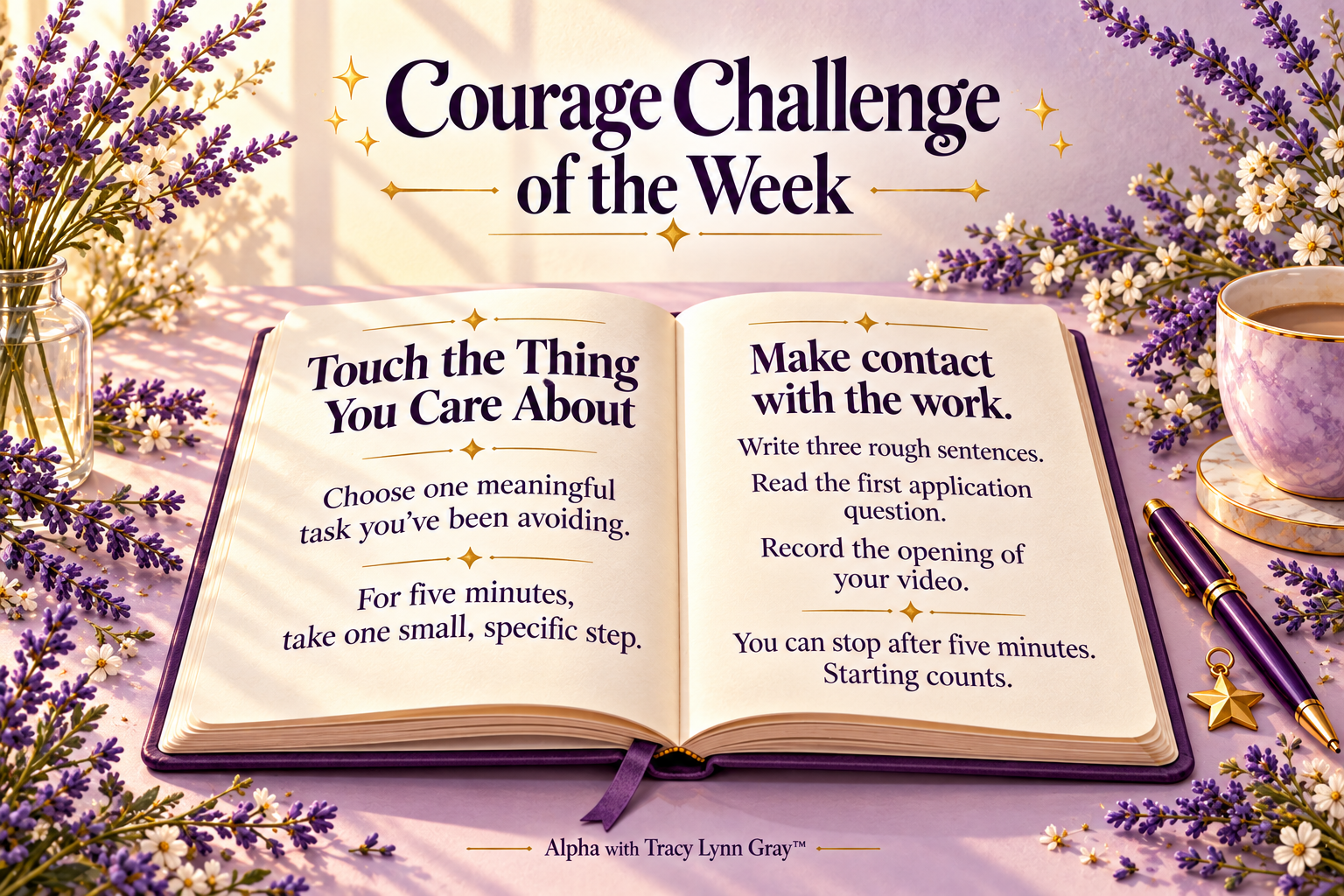
Choose one meaningful task you’ve been avoiding.
Then complete this sentence:
“For five minutes, I’ll ______.”
Make the action specific enough that you know exactly how to begin.
Open the document and write three rough lines.
Find the application and read the first question.
Record the opening of the video—even if you stumble.
When the five minutes end, you can stop or continue. Both choices are allowed.
Before you move on, notice:
What made starting difficult? What helped? What could make the next attempt easier?
Kevin may insist five minutes won’t change your whole life.
Tell him we’re opening the document, dude. Let’s keep the agenda reasonable.

Final thought
There’s a particular ache in watching yourself avoid something you want.
You can start questioning your discipline, your desire, even your ability to follow through.
Be careful with the conclusions you draw while you’re struggling.
A difficult start tells you something needs attention. It might be the task, the pressure around it, your available energy, or the support you need.
You’re allowed to approach something meaningful with shaky hands and an unfinished plan.
Today, give yourself one small chance to participate in what you care about.
One sentence. One question. One imperfect beginning.